Logistics

Multimodal logistics from Central Asia to the EU, managed from Riga

Rail, sea, road and air — one end-to-end chain instead of four contracts.

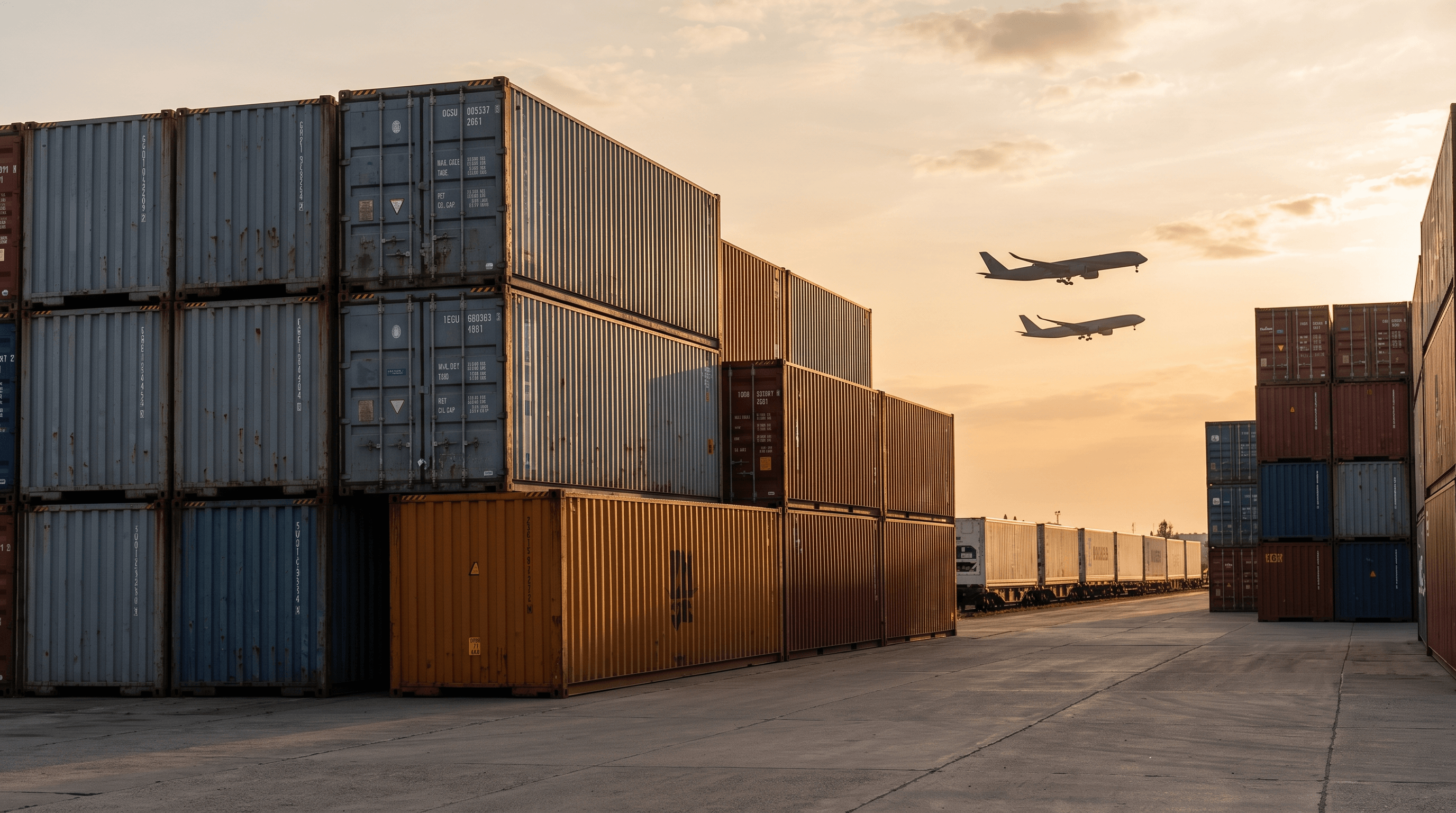
We plan and run deliveries from Uzbekistan, Kazakhstan, Kyrgyzstan, Tajikistan and Turkmenistan to the recipient in the EU as a single chain rather than a set of disconnected freight-forwarding contracts. The base route is the Trans-Caspian (Middle) Corridor: Tashkent or Almaty by rail to Aktau, then the sea leg to Baku and Alat, transhipment to Poti in Georgia and the final leg to Riga. The work also covers the Tashkent–RIX air leg for urgent consignments and the road leg through Kazakhstan and the Northern Corridor as a reserve for sea-leg overload. The assembly point in Latvia is our part of Uriekstes iela 4A in the Sarkandaugava industrial cluster near Riga Free Port: 2,934 m² of functional zones under one roof, of which 1,440 m² is the warehouse area acting as a transit hub for European supplies. On this site we unload the container, reconcile the batch against documents, relabel cartons where needed and assemble the outbound consignment for the buyer.

Multimodal logistics between Central Asia and the EU via Riga

Quick answer

Can a Central Asia–EU supply chain be run through one operator in Riga?

Yes. One Latvian trading house runs the rail, sea, air and road legs as a single end-to-end route with one documentary map. Logistics is assembled around the product category, the target lead time and the destination country, not from a template route. Buyer and shipper see the same key checkpoints: the loading window, the Caspian transhipment, the release at Poti, the receiving at Uriekstes 4A and the outbound dispatch.

Base corridor
Trans-Caspian (Middle): Aktau → Baku/Alat → Poti → Riga
Air leg
Tashkent ↔ RIX, 16 km to the warehouse facility
Assembly point
Uriekstes iela 4A, Riga LV-1005 — 2,934 m² of functional zones, of which 1,440 m² is the warehouse area
Backup route
Road leg through Kazakhstan when the sea leg is overloaded

Scope of service

What logistics support covers

The service is designed for teams that need a predictable lead time and a single point of accountability for the delivery. Six modules cover the full path from the producer's warehouse to the buyer's receiving in the EU.

  • Route design

    We build a route matrix per category: rail, sea, road or air — in the combination that produces the best lead time against cost. The matrix already factors in Caspian seasonality, the Aktau and Poti transhipment windows and the risk of congestion on the Latvia–Lithuania and Estonia–Russia borders.

  • Trans-Caspian corridor

    We run the rail leg to Aktau, book the Aktau ↔ Baku/Alat ferry window, monitor receiving on the Azerbaijani shore, order onward transport to the port of Poti in Georgia and the final leg into Riga. Every junction has its own checkpoint where documents and the physical batch are reconciled.

  • Tashkent ↔ RIX air leg

    Used for urgent consignments, document-sensitive items and pilot shipments. RIX sits 16 km from the warehouse facility in Sarkandaugava, which allows same-day receiving without intermediate storage at a cargo broker.

  • Road leg as a reserve

    When the Caspian ferry window closes or the sea leg is overloaded by seasonal peaks, we switch to the road leg through Kazakhstan into Latvia without reissuing documents. The reserve route is designed in advance rather than improvised on the day of disruption, so switching takes hours rather than weeks.

  • Documentary support for transport

    Consignment notes, transit documents and packing lists are prepared and reconciled in parallel with the movement of the goods rather than after the fact. This narrows the risk of a gap between the actual route and the customs records.

  • Deviation management

    A missed window, packaging damage, a customs query or a power loss at the terminal are handled by a fixed protocol: deviation owner, refresh deadline, new arrival estimate. Buyer and shipper receive a single status update with a new ETA rather than several conflicting notes.

Why Riga

What an assembly point in Latvia gives Caspian-region routes

Riga Free Port, the RIX airport cargo hub, the rail hub and the Sarkandaugava industrial warehouse cluster all sit on a short arm — tens of minutes by road, not hours. This reduces the number of handoffs between contractors and lets us change modality without losing a day to intra-city transport.

On the regulatory side, Latvia provides EU jurisdiction with a transparent enterprise register, uniform food and customs law and predictable behaviour from the relevant authorities. This matters for perishable categories and for batches carrying halal certification.

The facility on Uriekstes iela 4A in Sarkandaugava — 2,934 m² of functional zones under one roof, with the warehouse area of 1,440 m² acting as a transit hub for European supplies — lets us receive a container and assemble an outbound consignment for another buyer in parallel, which cuts stock idle time and keeps the replenishment rhythm on the recipient side.

What we control

How lead time is held inside a multimodal project

The lead time is not held together by verbal promises from carriers and brokers. It holds because of checkpoints: the actual loading window at the producer, departure from the Aktau terminal, receiving on the Azerbaijani shore, release at Poti, container receiving at Uriekstes 4A. Each checkpoint is a timestamped record rather than a chat message.

Alternative legs are booked ahead. If the Aktau ↔ Baku leg narrows because of winter storms or ferry maintenance, the container leaves via the road leg without reissuing documents. This reduces the buyer's idle stock.

Efficiency is analysed by direction, modality and recipient cluster. The accumulated delay statistics are used to adjust the next routes, not for after-the-fact reporting.

Primary direction

How this service works for the Uzbekistan ↔ EU trade lane

Uzbekistan is the primary direction of Trade House ECLECTIE. This service runs in tandem with procurement in Tashkent and the regions, halal certification, EU customs, the Riga warehouse at Uriekstes iela 4A and trade representation across the Baltic, Scandinavia, Poland and Germany — under one Latvian SIA, one set of documents and one contractual counterparty in the EU.

Trade House. Uzbekistan direction.

FAQ

Central Asia–EU logistics: frequent questions

Full route control. Freight booking is one of six modules; route design, documentary support, customs coordination, warehouse assembly at Uriekstes 4A and the deviation-handling protocol are added on top. Buyer and shipper share one timeline and one contact channel.

Launching the route

Design a route from Central Asia to the EU with a single operator

Send the country of origin, the product profile, the monthly volume and the target delivery windows. We will assemble the route per category, set the backup leg and prepare the checkpoints for a practical launch.

Multimodal logistics from Central Asia to the EU via Riga