
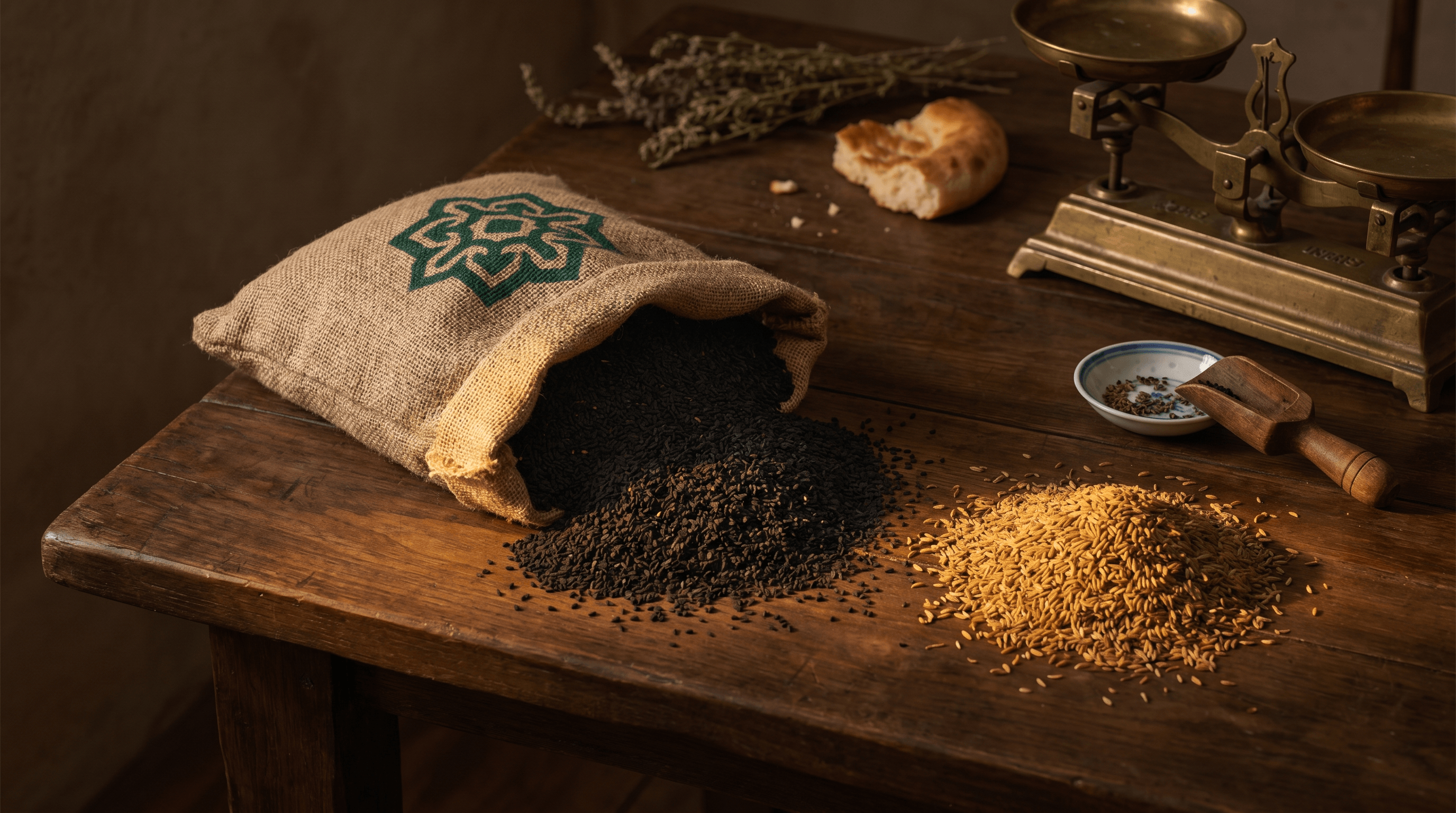
Two botanical species: black and white zira
On post-Soviet markets the single word "zira" covers two different products, and an importer bringing zira into the EU should pin down the difference in the specification before the contract is signed. Black zira is Bunium persicum, a plant that grows both wild and in cultivation, with narrow dark seeds, a strong smoky aroma and a higher essential oil content. White or yellowish-brown zira is Cuminum cyminum, the cumin of Indian, Mexican and Middle Eastern cooking, where it is an everyday seasoning.
Uzbekistan supplies both, and they sell on different shelves. Black zira sits in the premium niche: classic plov and restaurant tasting menus. White zira stays a volume category for retail chains and industrial blends. In B2B documents the two should appear as separate line items, each with its own botanical name and its own price per kilogram.
Two layers of requirements: EU law and the buyer's specification
Split the batch parameters for the EU market into two layers. Otherwise the same figure drifts between "required by law" and "wanted by the buyer" and stops carrying much weight. The first layer, the EU legal requirements, covers everything a batch needs to be imported at all and accepted by the trade. It includes consumer labelling under Regulation (EU) No 1169/2011; contaminant limits under Regulation (EU) 2023/915, which replaced Regulation (EC) No 1881/2006 from 25 May 2023 (for spices, the contaminants that matter most are aflatoxins and ochratoxin A); the general food law framework of Regulation (EC) No 178/2002, with batch traceability under Article 18; hygiene in production and storage under Regulation (EC) No 852/2004; the EU-wide rules on pesticide residues; and the sanitary and phytosanitary requirements for spice imports.
The second layer, the buyer's commercial specification, is made up of the technical parameters a buyer uses to separate the premium shelf from the mass-market one. No specific EU regulation sets them. They are written into the contract specification and the batch spec sheet. The basic parameters for zira are essential oil content, moisture, the share of foreign matter and the share of broken seeds, and each buyer sets the actual thresholds for its own channel.
- EU law: labelling under 1169/2011, contaminant limits under 2023/915, batch traceability under 178/2002, hygiene under 852/2004, pesticide residues, plus sanitary and phytosanitary import requirements.
- Essential oil (typical buyer spec): premium from 2%, standard from 1.5%, and anything lower goes to the industrial channel.
- Moisture (typical buyer spec): below 10%, so the seed stores well and keeps a stable aroma on the shelf.
- Foreign matter (typical buyer spec): below 1% for retail, with 0.5% or less as the benchmark for premium.
- Microbiology and charts of limits: retail chains' specifications are often stricter than the EU minimum and are agreed in a separate technical annex to the contract.
Cleaning and preparation: gravity separator, magnets, sieves
For a batch to pass the intake checks of a retail chain or a HoReCa distributor every time, it goes through a cleaning line between harvest and shipment. A gravity separator removes stones, grit and empty seeds by density. Magnetic traps take out metal particles that can get into the product during transport and packing. Sieves of different mesh sizes grade the batch by seed size and remove dust and fines.
Grinding is a separate stage with its own economics. Whole zira keeps longer, travels better and holds on to its essential oils. Ground zira is more convenient for industrial blends and retail chains, but it needs tighter packaging and temperature control, and its shelf life is shorter. The contract states the product format (whole, cracked or ground) on a separate line.
Packaging by channel: HoReCa, retail, industrial B2B
The pack format determines the channel, and often the final price as well. For HoReCa we use a 1 kg laminated zip-lock bag with a heavy foil inner layer: it is easy for a chef to work with, and it keeps the aroma after the pack has been opened. Retail chains ask for 50 g or 100 g packs with a clear window, an EAN-13 barcode and the information required by Regulation (EU) No 1169/2011 in the language of the destination country. The industrial channel needs 25 kg polypropylene sacks for blending lines and large catering contracts.
Each pack format needs its own set of documents. Retail needs full labelling with ingredients, allergens and storage conditions; HoReCa needs a product specification and a certificate of origin; industrial buyers need a technical specification and a batch certificate. Documents that do not match the pack format are one of the most common causes of claims on a first shipment.
Importing into the EU: CN codes, origin and labelling
White zira (cumin) enters the EU under Combined Nomenclature codes 0909.31 (neither crushed nor ground) and 0909.32 (crushed or ground). For black zira (Bunium persicum), confirm the code when the batch is classified. The codes go into the specification and the import file before shipment, together with proof of origin and the documents for the chosen tariff regime. Consumer packs are labelled under Regulation (EU) No 1169/2011: list of ingredients, information on possible allergens, storage conditions, country of origin and lot identification.
- Set out the botanical species and the SKU in the contract: Bunium persicum (black) or Cuminum cyminum (white).
- Agree thresholds for essential oil, moisture and foreign matter, and link the price per kilogram to them.
- Choose the pack format for the channel (HoReCa, retail or industrial) and prepare a separate set of documents for each format.
- Settle the CN code (0909.31 or 0909.32 for cumin), proof of origin and labelling under Regulation (EU) No 1169/2011 at the pre-export check.
The contract and the operating base: what to agree from the first batch
Four annexes matter in a B2B contract for zira. The first is the technical specification of the product: botanical species, essential oil, moisture, foreign matter and microbiology. The second is the packaging specification for the channel: format, materials and labelling requirements. The third, the operational annex, describes the route: the supply corridor, transshipment points and insurance. The fourth covers documents: CN codes, proof of origin and the requirements for laboratory reports on each batch.
An operating base in Latvia makes all four annexes easier to manage. At the warehouse at Uriekstes iela 4A, each batch is photographed and its labelling checked before it ships to a buyer in the Baltics or Scandinavia. The laboratory reports go into the batch archive, and if anything needs correcting, it is done on site, without sending the batch back to the producer. That way, zira supply becomes a repeatable commercial process with clear lines of responsibility.
EU buyers look at three figures for zira: essential oil, moisture and purity. Together they decide whether a batch goes to the premium or the mass-market channel.