
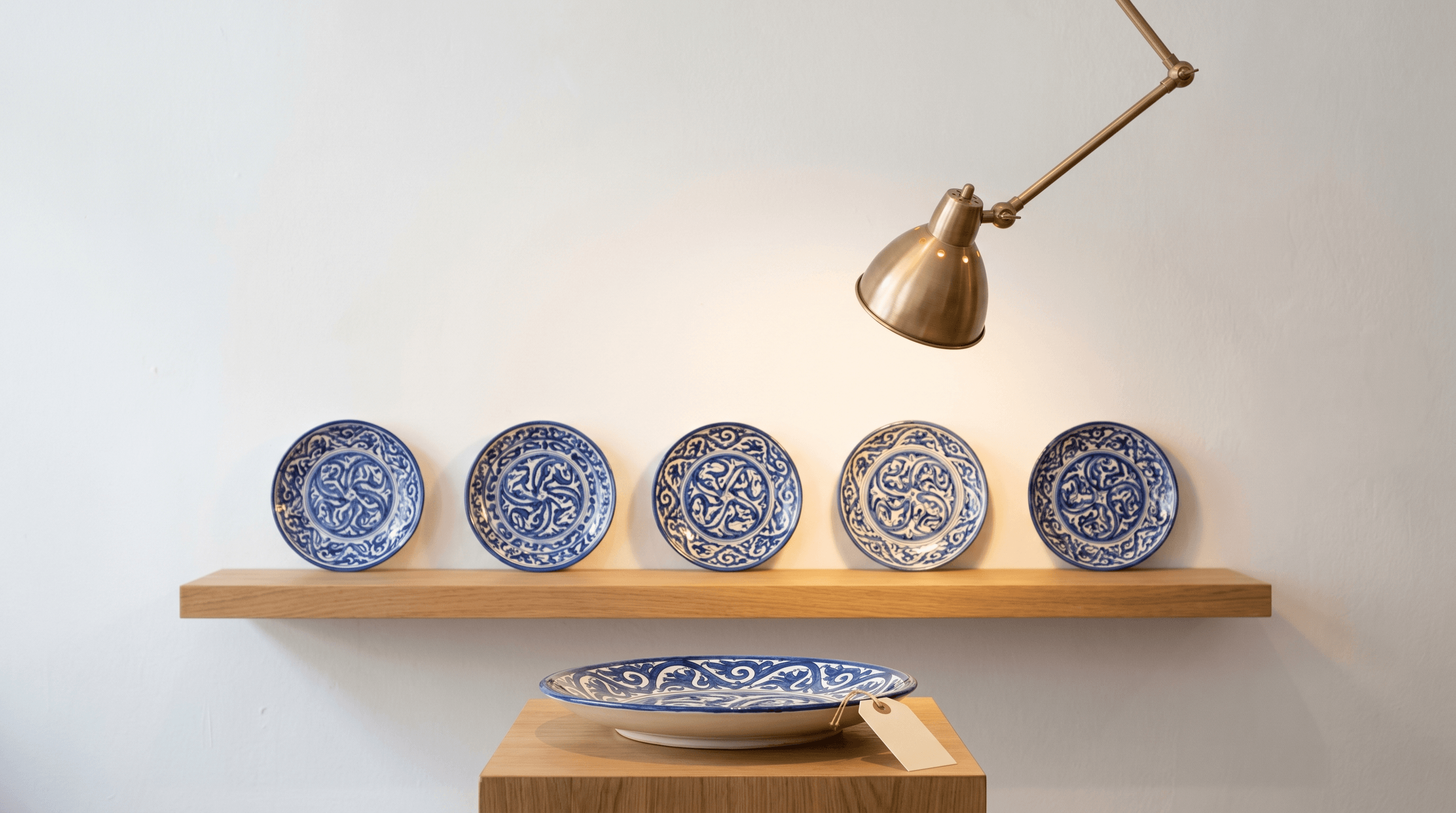
Rishtan and ishkor: the craft profile and why it matters on the shelf
Rishtan is a small town in the Fergana Valley and a centre of Uzbek ceramics, with a school of potters that goes back centuries. Technically, what sets Rishtan ware apart is its ishkor glaze, an alkaline glaze made with the ash of Salsola plants (saltwort, called ishkor in Uzbek). The alkali from the ash gives the surface a soft sheen and the recognisable depth of the painted pattern. The turquoise and blue tones come from mineral oxides of copper and cobalt.
The cobalt-blue palette is easy to recognise, but colour on its own proves nothing about authenticity, let alone food safety. In the EU, any public claim such as "food-safe" has to be backed by a laboratory migration test report and the manufacturer's Declaration of Compliance. The food-contact section below covers this in detail.
Rishtan work is also recognisable by its motifs: the pomegranate, the almond-shaped leaf, the eight-pointed star and the meander border. In a genuine batch the pattern varies slightly from piece to piece, a sign that it was painted by hand rather than stamped. For a concept store, these variations become part of the story it sells.
Food contact in the EU: Regulation (EC) No 1935/2004 and migration limits
If a piece is sold as a food-contact article (tableware, serving pieces or tea sets meant to be used with food and drink), the EU applies Regulation (EC) No 1935/2004, the horizontal regulation on materials and articles intended to come into contact with food. Ceramics are also covered by Council Directive 84/500/EEC (as amended by Directive 2005/31/EC), which sets specific migration limits for the finished article. Compliance is shown by the manufacturer's Declaration of Compliance plus a migration test report from an accredited laboratory on a representative sample from the batch.
Without this package, Rishtan ceramics cannot go on an EU shelf as food-contact ware: the cobalt palette, the craft history and the workshop's in-house certification are no substitute for a laboratory report. By default, then, we label and position the pieces as **decorative, not for food contact**, and open a separate food-contact line only for batches with a completed Declaration of Compliance and a current migration test. For a concept store this reduces regulatory risk and keeps the door open to a wider range once the laboratory package is in place.
The cost of breakage: insurance and packing for an Aktau→Riga container
The Aktau–Baku–Poti–Riga route includes two sea crossings and two transfers between rail and sea, which raises the risk of physical damage. From what we have seen on container shipments of Rishtan ceramics, the expected share of broken pieces is around 3–7% with standard packing: foam pads, cardboard cells and a top collar. This is an operational estimate based on our shipments, not industry statistics; the figure in a given contract depends on the carrier, the packing and the season.
Tighter individual packing brings breakage down to about 1–2% (again based on our shipments): each piece sits in its own cardboard cell, bubble wrap goes between the rows, and foam sheets at least 30 mm thick cushion the top and bottom of the case. Pallets with corner protectors and strapping add a further layer of protection. This packing adds about €0.80–1.50 per piece and pays for itself because more of the range arrives intact.
Cargo insurance is a separate part of the economics. In our experience, the typical premium for a batch of Rishtan ware on the Trans-Caspian corridor is around 0.4–0.8% of the declared value of the goods, with a deductible that applies to breakage claims. This is an operational estimate; the insurer sets the actual rate for each batch. Standard cargo insurance covers physical loss of or damage to the goods, which here means breakage. Consequential loss, such as a missed display slot at a concept store, an SLA penalty or the cost of reissuing documents, is normally excluded from cover.
Origin and storytelling: what a concept-store buyer needs
A shopper at a concept store in Stockholm, Berlin or Helsinki buys a story along with the tableware: where it comes from, the potter's school, the glaze technique and the firing method. That story is told in the shop window, on the shop's website and on a leaflet placed next to the piece. Without a verified story, a Rishtan plate loses out to a cheap factory-made copy.
SIA SLB LV (reg. No 40203742984), the logistics partner for Rishtan ceramics, keeps an audit trail for every batch, from the workshop in Rishtan to the pallet in the Uriekstes iela 4A warehouse. The concept store therefore receives verifiable proof of provenance with the goods: the potter, the production date, the series and a description of the glaze. Where a batch is sold as a food-contact line, the Declaration of Compliance and the accredited laboratory's migration test report are added to this package.
Pricing for the EU shelf: handwork and RRP in euros
In the EU, the price of Rishtan ceramics is driven by the potter's handwork; materials account for 20–30% of it. The hourly rate of an Uzbek kulol (master potter) is modest by European standards, but each plate represents 6–12 hours of work: shaping, drying, glazing, painting and firing.
The recommended retail price (RRP) on a concept-store shelf depends on the category. Decorative plates of 18–22 cm usually sell for €35–65, deep bowls of 14–16 cm for €25–40, choynaks (teapots) for €60–120 and tea sets of 4–6 pieces for €90–180. At these prices a concept store can work on a 40–60% margin and still price competitively.
SKU mix: plate, bowl, piyola, choynak
For an EU concept-store shelf, the best SKU mix is built around four core formats. The decorative plate (18–22 cm) turns over fastest: it is the core SKU and sells both as a souvenir and as decor. The 14–16 cm bowl is a functional item, in demand for serving modern bowl food and poke.
The 8–10 cm piyola (tea bowl) is a compact SKU for serving tea and for putting spices on the table. The choynak (a 600–900 ml teapot) is the premium item and the centrepiece of the display; a shop usually keeps one or two. Sets also sell well: a choynak with four piyolas makes a ready-made gift. Suzani and ikat textiles are a separate product line and do not overlap with the ceramics.
- Decorative plate, 18–22 cm: core SKU, turns over 4–6 times a year, RRP €35–65.
- Bowl, 14–16 cm: functional item, turns over 3–5 times, RRP €25–40.
- Piyola, 8–10 cm: compact SKU for serving tea, RRP €12–22.
- Choynak, 600–900 ml: premium centrepiece of the display, slow turnover, RRP €60–120.
- Tea set (choynak and four piyolas): gift set for seasonal peaks, RRP €90–180.
A concept store in Stockholm buys Rishtan with verified origin, a clear story behind the cobalt glaze and correct food-contact labelling. Without these, a piece loses out to a cheap mass-market copy.