
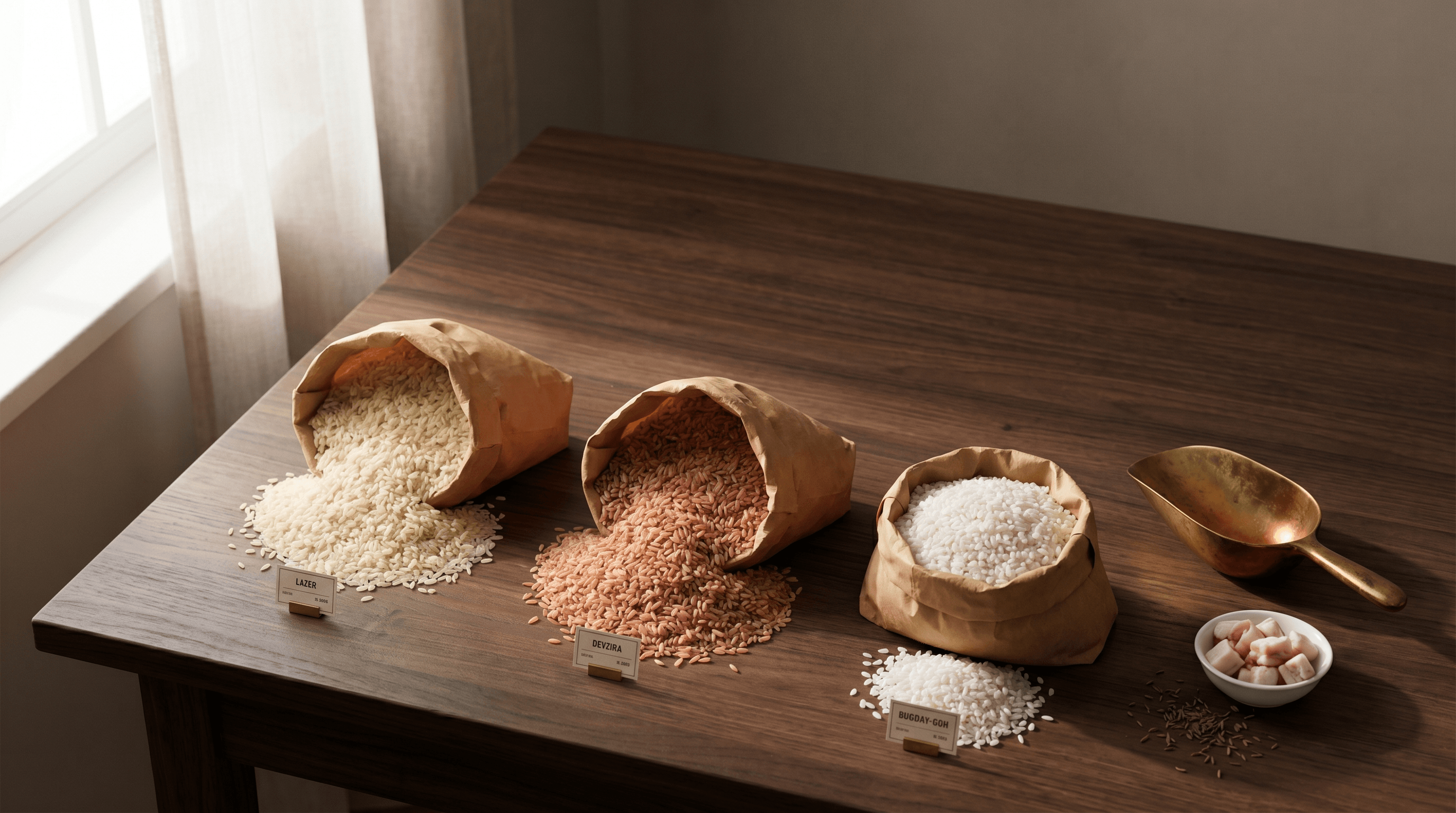
Four lines: Laser, Devzira, Bugday-Goh, Khorezm rice
Laser is a mass-market variety from Chust in the Fergana Valley. The grain is medium in length, white after milling, with no pronounced reddish coat. It behaves predictably in cooking: the grains stay separate, do not stick together and take up water at a ratio of about 1:2.2–2.4. It is the versatile rice for everyday Uzbek plov, and buyers in the Baltics and Scandinavia know what to expect from it.
Devzira is a premium variety from Chust and Uchkurgan. The grain is medium in length, heavy and dense, with a characteristic red-brown coat and a lengthwise stripe that partly survives milling. Devzira needs a longer cooking cycle and takes up more water, at a ratio of about 1:2.8–3.0. Cooked properly, the grain holds its shape and gives the plov a rich flavour. It is the classic choice for festive, Fergana and Samarkand plov.
Bugday-Goh is a Khorezm variety that sits between Laser and Devzira: a medium, dense grain that is moderately thirsty in the pot. Khorezm rice is a generic name for rice from the Khorezm region, not tied to a particular variety. It is the entry-price line, a steady seller in the distribution channel and in mid-priced HoReCa.
Technical parameters: moisture, ratio, cooked yield
Moisture is one of the main acceptance parameters for milled plov rice. For long storage and transport the limit is 14% (typically 12.5–13.5%). Above 14%, the risk of mould and of grains sticking together rises on the long journey through the Trans-Caspian corridor. Moisture below 11% is not ideal either: the grain becomes brittle and more of it breaks during milling.
The length-to-width ratio shapes how the rice looks and how it comes across in the dish. For Laser the typical ratio is 2.8–3.2 (medium grain) and for Bugday-Goh 3.2–3.6. For Devzira, a dense medium grain, it is recorded batch by batch. These parameters are measured on a representative sample of the batch and recorded in the specification together with the share of broken grain (no more than 5% for premium, no more than 10% for the mid segment).
Cooked yield is a practical figure for the chef: how many grams of cooked rice you get from 100 g of raw rice. For Laser it is about 250–270 g, for Devzira 280–310 g and for Bugday-Goh 260–280 g. These figures go into HoReCa recipe cards and into plov costings for retail food production. A cooking test is run when the batch is accepted.
CN classification (1006.10 / 1006.20 / 1006.30 / 1006.40) and origin records for EU imports
The EU Combined Nomenclature (CN) classifies rice by the physical state of the grain. Heading 1006 covers rice as a whole, and the subheadings within it are defined by the degree of processing. Rice in the husk (paddy or rough rice) falls under CN 1006.10. CN 1006.20 is husked rice (brown or cargo rice), which keeps its bran layer because only the husk has been removed. CN 1006.30 covers semi-milled and wholly milled rice, ready for retail packing. Broken rice has its own code, CN 1006.40. Most plov rice moves under 1006.30, including milled Devzira that keeps part of its bran layer. Only batches from which just the husk has been removed go under 1006.20. The variety (Laser, Devzira, Bugday-Goh, Khorezm) is recorded in the commercial documents as a product characteristic and does not affect the CN code.
Rice from Uzbekistan can enter the EU under GSP+ if the CN line in question is covered by the preference. Check this before shipment, together with the exporter's REX number and a correctly made-out statement on origin. GSP+ reduces or removes the customs duty on the lines concerned. Origin records usually state the country of origin (Uzbekistan), the growing region, the harvest year, and the batch series and lot code. That gives the batch traceability required by Article 18 of Regulation (EC) No 178/2002.
Price tiers: premium Devzira, mass-market Laser
Price tiers on the EU shelf follow the variety and the pack format. Laser in 1 kg retail packs is a mass-market line, with a typical RRP of €4.50–7 per kg depending on the country and the chain. Devzira in 1 kg packs sells as a premium line at €12–22 per kg. Bugday-Goh sits in the middle at €7–10 per kg.
HoReCa works with different formats: Laser and Bugday-Goh in 5, 10 and 25 kg sacks, Devzira in 1–5 kg packs for premium dishes. A HoReCa distributor in Stockholm or Berlin usually stocks two lines, a volume one (Laser or Bugday-Goh) and a premium one (Devzira), and prefers to buy both from one supplier.
Container economics: sacks or bulk
Whether to ship in sacks or in bulk depends on two things: the target channel and the planned volume. For a retail chain, rice travels in finished consumer packs of 0.5–2 kg or in 5–25 kg HoReCa sacks. Bulk (a 20-foot container loaded loose or with big bags of 50–1,000 kg) is for industrial buyers: makers of ready meals and plov kits, and retail private labels.
On the Trans-Caspian corridor, it is important to keep an eye on the humidity inside the container. Ventilating the container and adding desiccants (silica gel or moisture-absorbing bags) lowers the risk of condensation on the top layers of the cargo. For rice with an upper moisture limit of 13.5%, the right packing gets the batch to Riga with no loss of quality.
Quality checkpoints: cooking test, moisture meter, sieve sizing
The basic intake protocol for a batch of rice at the Uriekstes 4A warehouse has three main checks. First comes the cooking test: a 100 g sample is cooked, and the cooking time, the behaviour of the grain, the yield and the sensory profile are recorded. Next, an electronic moisture meter measures moisture at several points in the sack or container. The third is sieve sizing: sifting through calibrated sieves confirms that the grain size is uniform.
- Cooking test: 100 g of rice and 200–300 ml of water (depending on the variety), cooked until fully done, with the cooking time and the weight of the cooked rice recorded.
- Moisture meter: at least five measuring points per batch, with the average and the maximum recorded.
- Sieve sizing: four calibrated sieves in 1 mm steps, with the percentage in each fraction recorded.
- Foreign matter check: visual inspection for foreign matter, with no more than 0.3% by weight allowed.
- Broken kernels: the share of broken grain is counted, with up to 5% allowed for the premium segment and up to 10% for the mid segment.
An EU category manager buys to a specification: Laser with a stated length-to-width ratio and moisture, or Devzira with a declared cooking ratio of 1:2.8. Those figures have to be in the specification, in writing.