
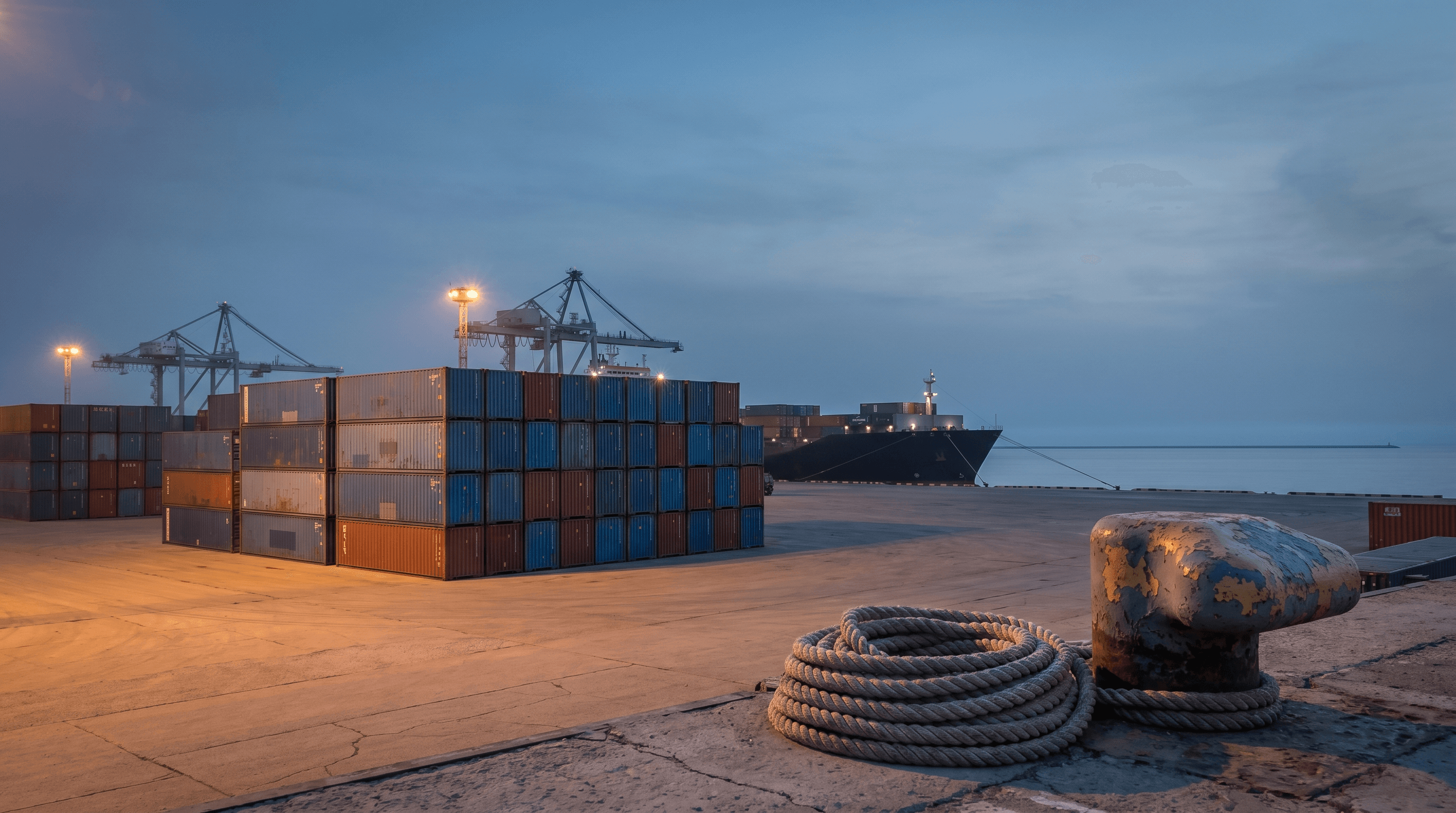
The corridor's geography: five legs from Tashkent to Riga
The Trans-Caspian corridor, known in the international literature as the Middle Corridor (Trans-Caspian International Transport Route, TITR), is a network of multimodal routes between Central Asia and Europe across the Caspian Sea, the Caucasus and the Black Sea. Within this network we put together a working five-leg configuration for deliveries to Riga. The first leg is by rail: a container train leaves Tashkent and runs across Kazakhstan to the seaport of Aktau on the eastern shore of the Caspian. On the second leg the cargo crosses the Caspian from Aktau to Baku or the neighbouring Alat terminal in Azerbaijan. The third leg runs overland through Azerbaijan and Georgia. The fourth takes the cargo to the Black Sea port of Poti, from where it continues by sea; instead of this leg, the cargo can travel by rail on the Baku–Tbilisi–Kars line into Turkey. The fifth leg completes the route with a final multimodal haul from the Black Sea coast to the Freeport of Riga and the operating warehouse at Uriekstes iela 4A in Sarkandaugava.
This is one of several workable ways to assemble the route. Depending on the cargo category, the season, ferry availability on the Caspian and slots at Poti or Burgas, the same checkpoints can be combined differently: with a different Black Sea exit port, by switching between the sea leg and the BTK rail leg, or by routing overland through Turkey. The forwarder fixes the exact legs, schedules and transit times against the current season's timetable, and the commercial offer confirms them with live rates.
Each leg has its own physical constraints: port capacity, ferry schedules, typical delay windows and the requirements of the container lines. Once these are laid out on one shared map, logistics can be managed as a product: the route is broken down into checkpoints, and these are built into commercial lead times in advance.
Aktau as the first multimodal hub: ferry schedules and turnaround
Aktau is the first truly multimodal hub on the corridor. Almost everything that happens afterwards depends on how well its terminals work and how closely the ferry lines keep to schedule. The arrival of the train from Tashkent is timed to the ferry loading window, and free ferry slots are allocated in advance, so a train running a few hours late can push the shipment onto the next sailing.
- Check the ferry schedule and the actual queue at the terminal before booking wagons on the Uzbek side.
- Build a buffer into contract lead times for slot changes when a storm warning is issued for the Caspian.
- Agree the hand-over of container and seal numbers with the receiving side in Baku before the ferry arrives.
The Caspian leg: container lines, seasonality and insurance
The sea crossing between Aktau and Baku or Alat is the part of the route most affected by the season. Storms on the Caspian are more frequent in winter, which slows vessels' approach to the terminal and makes the schedule less reliable. Batches without tight deadlines are therefore easier to plan for the settled-weather months.
The contract should name the transhipment port (Baku or Alat), the carrier and the insurance terms. A multi-leg route needs a policy that either covers each leg separately or stays in force through transhipment. Unless the policy covers them explicitly, incidents at borders and the reissuing of documents may end up at the shipper's expense.
The Black Sea leg: Poti, BTK and the route to the Baltic
Once through Azerbaijan and Georgia, the cargo reaches the Black Sea leg, which has two scenarios. In the first, it travels by rail on the Baku–Tbilisi–Kars line towards Turkey and then by road into Europe. In the second, it goes to the port of Poti and by sea to a European port, then on by rail or road to Latvia.
When we plan the route to the Uriekstes iela 4A site, we choose the scenario with the more predictable transit time and the steadier price. The site is in Sarkandaugava, an industrial area next to the Freeport of Riga, so the final leg from the sea terminal to our warehouse is short and easy to control.
Backup options: air freight and a second route
Air freight from Tashkent to RIX is the backup for urgent, time-sensitive batches, or for periods when peak traffic on the Caspian leg causes delays in transit. The choice of leg rests on several factors taken together: transit time, cost, the buyer's requirements for proof of origin, sea conditions on the Caspian and the slots available at the transhipment ports.
The backup is worked out in advance as a second route with its own document set, insurance cover and an agreed hand-over point for the cargo. In a stable season it stays on standby; if the main corridor is delayed or closed, it can be activated without lengthy extra approvals. As a result, the price and transit time on the multimodal route stay predictable even when individual legs suffer seasonal or operational disruption.
- Fix the main route for the season and give each leg a checkpoint with a named owner.
- Agree the backup scenario with the buyer before the pilot shipment, so that it does not have to be negotiated on the day of delivery if something goes wrong.
- After two full cycles, compare planned and actual transit times leg by leg and adjust the insurance to the real risks.
Route checkpoints and pre-export intake in Riga
Each leg of the corridor has its own set of checkpoints at which the batch is tracked on its way to Latvia. Where the rail leg leaves Uzbekistan, the checks cover container and seal numbers, the condition of the packaging, the temperature regime for sensitive categories and whether the accompanying documents are complete. On the ferry leg at Aktau, the hand-over to the carrier is recorded, along with the state of the documents at transhipment and the matching of container numbers to the bill of lading. On the Black Sea leg and at entry into the EU, the focus is on whether the physical goods match the declarations, whether the CN codes are correct and, where GSP+ is claimed, whether a valid REX number is in place.
The final checkpoint is intake at the Uriekstes iela 4A warehouse in Sarkandaugava, where the batch is photographed, its labelling is checked against Regulation (EU) No 1169/2011 and it is registered in the warehouse system. Any last corrections to documents and packaging are made here before the goods are distributed to EU countries. Linking the pre-export intake to the corridor logistics gives the route a single point of responsibility and an archive of evidence for every batch.
The corridor stops being a lottery once every leg has a name, an owner and a backup plan agreed before shipment.