
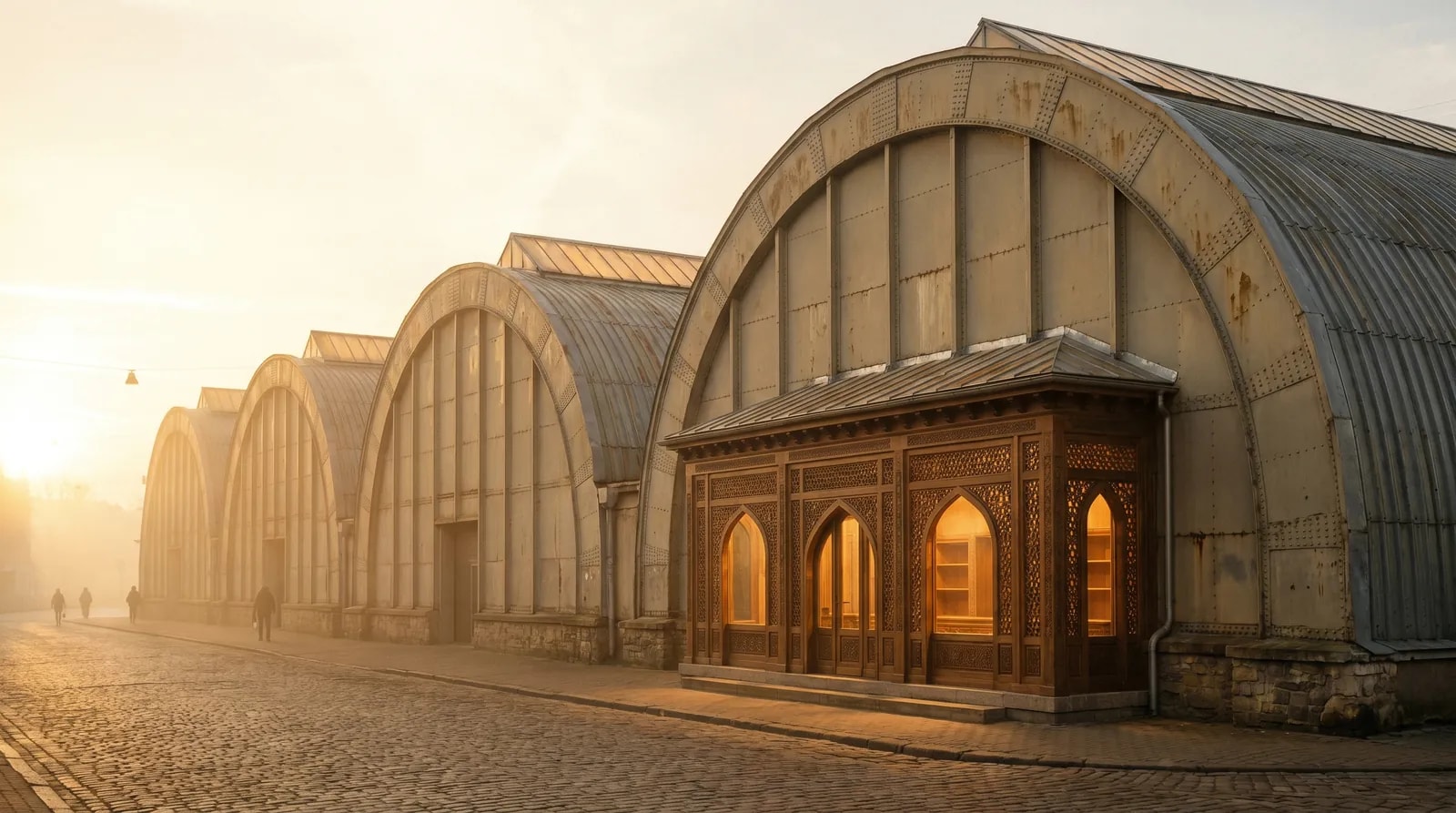
Riga Central Market at a glance
Riga Central Market, Rīgas Centrāltirgus in Latvian, is the city's main food market. It stands at Nēģu iela 7, next to the international bus station, a few minutes on foot from the railway station and close to the Spīķeri quarter of old brick warehouses.
Five huge arched pavilions form its core, with outdoor trading areas spread around them. It is one of the largest markets in Europe and part of the Historic Centre of Riga, a UNESCO World Heritage Site. Even the address is about food: nēģi are lampreys, a Latvian delicacy.
How to get to Riga Central Market
From the Old Town, walk. The market lies just south-east of the old streets, and the easiest landmark to aim for is the international bus station: the arched roofs of the pavilions rise right next to it.
Arriving by coach puts you on the doorstep, and the main railway station is a few minutes away on foot. If you are staying further out, trams and buses stop nearby; a journey planner will give you the current routes. The Spīķeri quarter is close by, so the market pairs easily with a wander through the warehouses or along the river.
How the market is laid out
The five main pavilions stand side by side, each a long hall under a high curved roof. Every pavilion has its own speciality, and the names describe what you find inside: meat, fish, dairy, vegetables and gastronomy.
Outdoor stalls fill the spaces around the halls and change with the seasons. There is no set route: start at whichever end you reach first and work across. If you only have an hour, choose two pavilions and the outdoor stalls instead of rushing through all five.
What each pavilion is known for
- Meat pavilion: fresh meat and poultry cut to order, plus smoked meats, bacon and sausages for a picnic.
- Fish pavilion: fresh fish from the sea, lakes and rivers, and long counters of smoked, salted and marinated fish. Herring comes in many forms, and smoked sprats are a Riga classic.
- Dairy pavilion: cottage cheese (biezpiens), sour cream, butter, eggs and farmhouse cheeses, including the caraway-seeded cheese Latvians eat at midsummer.
- Vegetable pavilion: vegetables, fruit, pickles and sauerkraut all year, with berries and wild mushrooms in season.
- Gastronomy pavilion: deli counters, baked goods and grocery stalls, a good place to look for food that travels well.
Tips for a good visit
- Go in the morning. The choice is widest and the aisles are calmer. Check current opening hours, for the market and for individual pavilions, on the market's official website before you go.
- Carry some cash. Many stalls take cards, but smaller traders and outdoor stalls may prefer cash, and coins speed up small purchases.
- Bring a bag. A sturdy tote for vegetables and bread, and a cool bag if you plan to buy fish, meat or dairy.
- Taste before you buy. Traders often offer a taste of cheese, honey, sauerkraut or smoked fish. Ask first, and buy something if you like it.
- Shop the season. Strawberries arrive in early summer, then blueberries and chanterelles; autumn brings apples, pumpkins and more mushrooms. In winter, pickles, preserves and smoked goods take over.
- Bargain gently, if at all. Prices are usually marked, often per kilo. Asking for a better price on a large quantity is acceptable; haggling over a single jar is not the local habit.
- Ask for small amounts. Most traders will weigh out a little, which makes it easy to taste your way around.
- Watch your belongings. As in any busy market, the aisles get crowded, so keep wallets and phones in a closed bag.
What to try or buy as a visitor
A first visit works well as a picnic assembled stall by stall. These either travel well or are best eaten on the spot:
- Dark rye bread, dense and slightly sweet-sour, a staple of the Latvian table.
- Smoked fish, bought by the piece and eaten outside on a bench.
- Sauerkraut, often sold from large tubs, to eat with smoked meat or sausages.
- Caraway cheese and fresh cottage cheese from the dairy pavilion.
- Latvian honey, and berries when they are in season.
- Something from the eastern corner: a bag of spices or dried apricots is light and keeps for months.
The eastern corner: Arkan Bazar
Not everything at the market is Latvian. Arkan Bazar, the Uzbek bazaar at Riga Central Market, formerly known as Uzbek Bazaar, brings Central Asian groceries and crafts to Riga. Its page has the map, the exact location and current hours.
Spices
Spices are kept in open jars and weighed to order, so you can see and smell them first. Zira, the cumin behind every plov, sits beside dried barberries, coriander seed and turmeric.
If the names are new to you, our glossary of Uzbek spice names gives the English and Latvian equivalents for each one.
Rice
Plov depends on the right rice, and the counter carries the two Uzbek classics: white laser rice for everyday plov and devzira, the heirloom rice for festive plov. Both are sold by weight as well as in packs. Devzira needs a long soak and more care in the pot; laser is the forgiving one, and the better choice for a first plov.
Dried fruit, nuts and tea
Uzbek dried apricots, raisins, walnuts, almonds and pistachios are sold by weight, and you can usually taste before you choose.
For tea, look for kok-chai, Uzbek green tea, and strong black tea. Both are traditionally drunk from small bowls called piyola.
Ceramics and textiles
The crafts are worth a look even if you came for food: Rishtan ceramics in their characteristic blue glazes, tea sets, suzani embroidery and ikat silk scarves. Textiles pack flat; ceramics need careful wrapping for the trip home.
Halal meat, coming soon
Arkan Bazar is preparing a halal meat pre-order: you order online, and Arkan Bazar's vans travel to different towns in Latvia to deliver the pre-ordered goods. It is launching soon, and you can join the halal meat waitlist now.
Shopping for plov? Pick up rice, zira and barberries at the bazaar, lamb or beef in the meat pavilion and carrots and onions in the vegetable hall, then follow our classic Uzbek plov recipe at home.
A short history: from Zeppelin hangars to a UNESCO site
Riga Central Market opened in 1930. Its five main pavilions were built using the frames of German Zeppelin hangars from the First World War, brought to Riga from Vaiņode in Kurzeme, in western Latvia.
The market is now one of the largest in Europe and part of the Historic Centre of Riga UNESCO World Heritage Site, and the city still does its daily food shopping under the old airship hangars.
Stand at the end of any pavilion and look up: the long, rounded roofline is the outline of a shed designed to hold an airship. These days it covers counters of cheese, fish, meat or vegetables.
If you take one thing home from Riga Central Market, make it food: a loaf of dark rye, a jar of honey or a bag of spices from the eastern corner.