
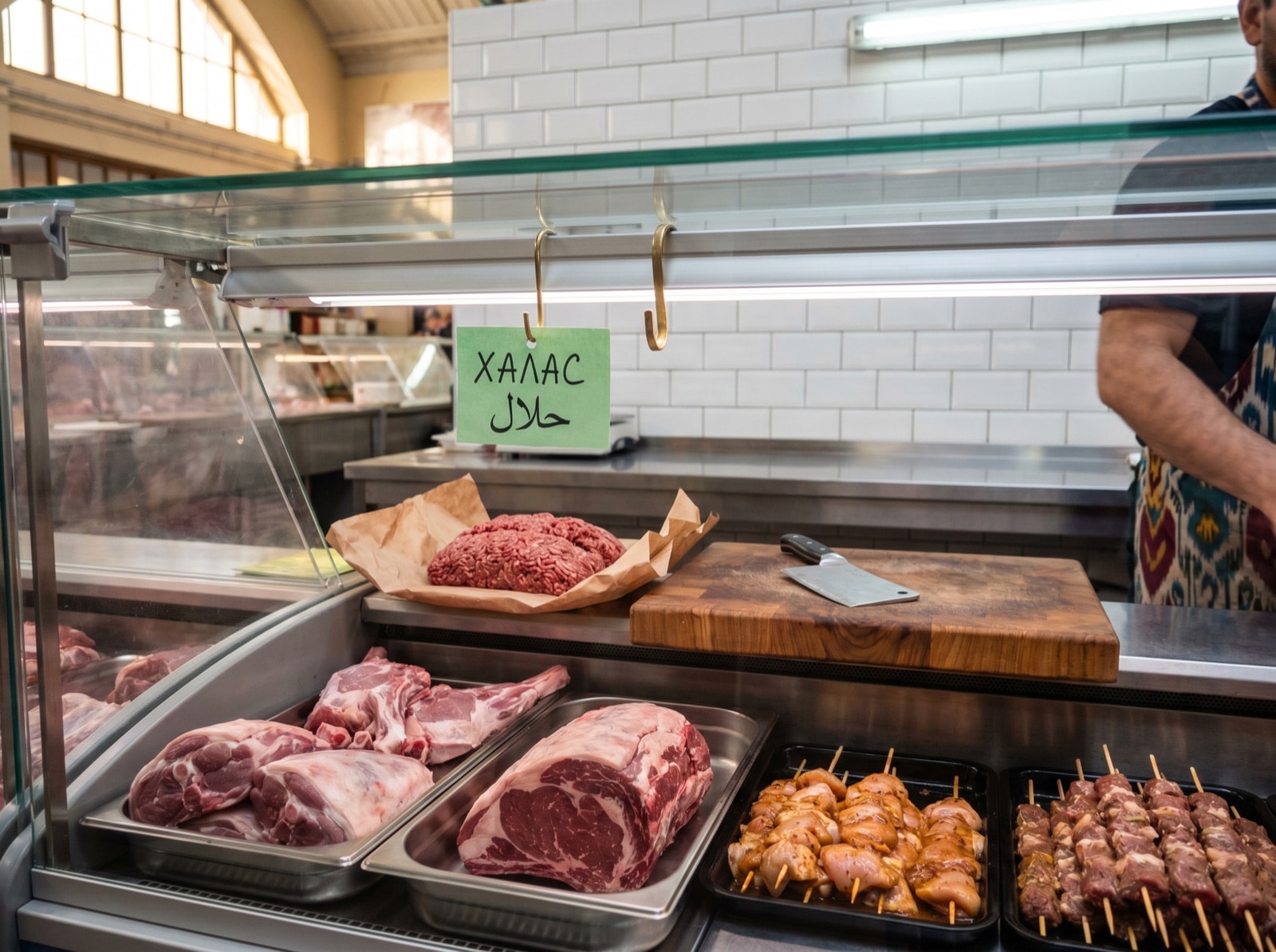
What does halal mean?
Halal is an Arabic word meaning "permitted" or "lawful". In Islamic dietary law it applies to all food and drink, not only to meat. Its opposite is haram, forbidden.
Between the two sits mashbooh, "doubtful": items whose status is unclear, for example because an ingredient or its source is unknown. Many Muslims avoid them until the doubt is resolved.
Most plant foods raise few questions. Meat raises the most, because the rules cover the animal itself, the way it was slaughtered and the way the meat was handled afterwards.
What makes meat halal?
Meat is halal only when several conditions are met together. If one of them fails, the meat is not halal, whatever the packaging says.
A permitted animal
Pork and anything derived from pigs are excluded, and so are carnivorous animals and birds of prey. Lamb, mutton, beef, goat and poultry are the halal meats most shoppers in Europe will meet.
A healthy, living animal
The animal must be healthy and alive at the moment of slaughter. An animal that died in any other way is not halal.
The slaughter: dhabiha
The slaughter, called dhabiha or zabiha, is carried out by a Muslim who pronounces the name of God. A swift cut with a sharp knife severs the throat, the windpipe and the main blood vessels of the neck, and the blood is drained from the carcass. Blood itself is not eaten.
No cross-contamination
Halal status can be lost after slaughter. Cutting, processing, storage and transport all have to keep halal meat apart from non-halal products, which in practice means separate equipment, separate storage and clear labelling along the chain.
Feed and welfare
Standards also set expectations about how the animal was raised, fed and treated before slaughter. The details vary from one standard to the next.
Who certifies halal meat?
Halal certification is carried out by private certification bodies. Each one audits slaughterhouses, processors and other businesses against a standard, either its own or a published one it has adopted, and allows approved products to carry its mark.
There is no single EU halal label, so marks differ from product to product. What a halal claim means depends on the certificate behind it: which body issued it, for which site, and against which standard.
Standards also disagree on substance. The best-known difference concerns stunning. Some standards accept certain forms of stunning before the cut, provided the animal is still alive when it is slaughtered; others accept no stunning at all.
To check a certificate, look at who issued it, which company, site and products it covers, and the period it is valid for. If anything is unclear, contact the issuing body directly. Our certification partner ALHALAL issues halal certificates.
If you buy or sell halal products as a business, our EU halal certification handbook covers standards, audits and marking in detail.
How EU rules frame halal slaughter
In the EU, the protection of animals at the time of killing is governed by Regulation (EC) No 1099/2009. As a general rule, it requires animals to be stunned before slaughter. It also allows a derogation for slaughter prescribed by religious rites, on condition that it takes place in a slaughterhouse.
The regulation lets member states keep stricter national rules. As a result, the rules on religious slaughter differ between EU countries, and halal meat sold in one country may have been produced under a different set of rules in another.
For shoppers, this means the word "halal" on its own does not tell you whether the animal was stunned. To find out, check the certificate and the standard behind it.
Sausages, mince and other processed meat
Processed products deserve a closer look than a whole cut, because more goes into them. Sausage casings, gelatine and some flavourings and additives can be derived from pigs, and any one of them makes a product not halal.
Mince and sausages also pass through more machines on their way to you, so the separation rules matter more. For processed meat, look for a certificate that covers the processing plant as well as the slaughterhouse.
Tinned meat follows the same logic: check the certifier's mark and read the full ingredient list, including the small print on stocks, fats and stabilisers.
How to buy halal meat: a checklist
- Ask which certificate applies. A good seller can name the certification body and the standard behind the meat, and should be able to show the certificate on request.
- Read the label. Look for the certifier's name or mark, the origin, the cut and the use-by date. A handwritten "halal" sign tells you far less than a certifier's mark.
- Check traceability. Ask where the animal was slaughtered and how the meat reached the counter. Halal status depends on every step in between.
- Look at the meat. Fresh red meat should look moist without being wet or slimy, and smell clean. Fat should be firm. Poultry skin should be dry and intact.
- Check the storage. Meat should be chilled, kept apart from non-halal products and wrapped so that juices cannot drip onto other food.
- Choose the cut for the dish. Bone-in lamb or beef for plov and soups; lean lamb with a little fat for shashlik.
Cooking with halal meat
Halal meat cooks like any other meat of the same cut and quality. Many Central Asian classics are built on lamb and beef, including these four:
- Classic Uzbek plov: lamb or beef on the bone, browned hard with onions and carrots before the rice goes in.
- Lamb shurpa: bone-in breast or neck, simmered slowly with whole vegetables for a clear broth.
- Marinated shashlik: lean lamb with onion, cumin and black pepper, grilled over glowing coals.
- Steamed manty: finely chopped lamb or beef with an equal weight of onion, wrapped in thin dough.
Uzbek cooks also value tail fat, kurdyuk, from fat-tailed sheep. It melts into the base of a plov and is threaded between the pieces of lamb on shashlik skewers to keep them juicy. Ask for it by name; it is not always on display.
Halal meat in Riga and across Latvia
In Riga, halal meat is sold by specialist shops and market counters, and some sellers take orders through delivery apps. The range of cuts varies from seller to seller, so it pays to ask in advance if you need something specific, such as lamb neck or offal.
Arkan Bazar, the Uzbek bazaar at Riga Central Market, is preparing a halal meat pre-order. You order online, and Arkan Bazar's vans travel to different towns in Latvia to deliver the pre-ordered goods.
The seller is Halal Latvia SIA, and the platform is operated by SIA "Trade House ECLECTIE", which also runs tradehou.se. The planned range includes lamb, beef, chicken, mince, offal, sausages and tinned meat. The pre-order is launching soon; until then, you can join the halal meat pre-order waitlist to hear when ordering opens.
Use the checklist above with this seller as you would with any other.
Halal covers everything from the animal to the counter. The certificate tells you who checked it, and against which rules.