
Is navat just sugar?
In composition, yes. Navat is sucrose, like granulated sugar, but it is left to grow slowly into large crystals. The crystals can be clear, milky white or amber, often with the cotton threads or wooden sticks they formed on still inside. That is why navat is sold in chunks and clusters.
Where navat comes from and what it is called elsewhere
Sugar was first crystallised in India. The skill passed to Persia, and Europe learned of it much later through Arab traders. The words travelled the same way: Persian qand became Arabic qandi, which gave English its candy and German its Kandis. Similar sugar is now made from Iran to China, and each country calls it something different.
- Uzbekistan: novvot; the Russian form navat is the one that stuck.
- Iran: nabat. Iranian nabat is often coloured yellow with saffron and sold as crystals on wooden sticks.
- Azerbaijan and Turkey: nabat and nebat şekeri, also taken with tea.
- India: mishri, eaten after meals with fennel seeds.
- China: bingtang, or "ice sugar", used in tea and sweet soups.
- English-speaking countries: rock sugar or rock candy; in Germany it is Kandiszucker, or simply Kandis.
How navat is made
The method has barely changed in centuries. All it needs is a thick sugar syrup, some thread and a few undisturbed days.
- Sugar is dissolved in hot water. Sometimes a little grape juice, saffron or another natural flavouring goes into the syrup.
- The syrup is boiled down until thick and poured into containers strung with cotton threads or fitted with sticks.
- The containers stand somewhere warm where nobody touches them. As the syrup cools, sugar settles on the threads as crystals. The slower it cools, the larger they grow.
- The leftover syrup is drained off, and the crystals are dried and broken into pieces.
The colour comes from the syrup. Plain sugar gives clear or white navat, grape juice and light caramelisation turn it amber, and saffron makes it yellow. To grow navat in your own kitchen, follow the step-by-step recipe "Navat for tea: make it at home" in our Uzbek recipe collection.
How navat differs from ordinary sugar
Both have the same energy value, about 400 kcal per 100 g. The difference is in the shape and in how people eat them.
- A large crystal dissolves slowly. A piece in the tea bowl sweetens the tea gradually, and nibbled on its own it lasts several sips.
- Granulated sugar is for cooking and baking. Navat is almost always served with tea and does not go into dough.
- Pale navat tastes of plain sweetness. Amber kinds can have a light caramel or grape note.
Navat, Kandis and sugar candy
Navat, German Kandis and the old-fashioned Russian sugar candy (sakhar-ledenets) are the same type of product: sugar grown into crystals from a supersaturated syrup. They differ in shape and additions. In Germany white Kandis is sold in large lumps and small grains, and brown Kandis is made from caramelised syrup. Navat usually comes as irregular clusters on threads, sometimes with grape juice in the syrup.
Boiled sweets and lollipops are made differently. Their sugar is cooked to a glassy state and cooled fast, so it never forms crystals. If a pack says "candy sugar", look at a piece: navat shows crystal faces, while a boiled sweet breaks smooth, like glass.
Is navat good for you?
Your body digests navat exactly as it digests sugar from the sugar bowl. Amber kinds carry traces of minerals from the grape juice, but far too little to matter nutritionally. The World Health Organization advises keeping free sugars below 10% of daily energy intake, and navat counts towards that limit like ordinary sugar.
In Central Asia and Iran people dissolve navat in warm tea or milk when they have a cold or a cough. It is a folk custom. There is no evidence that navat treats anything better than ordinary sugar or honey.
Can people with diabetes eat navat?
For people with diabetes, navat is no different from ordinary sugar: it raises blood glucose just as quickly. It goes into the daily carbohydrate count as sugar, and how much is acceptable is for their doctor to decide. Words like "natural" or "crystal" on the pack change nothing.
Why navat is served with tea
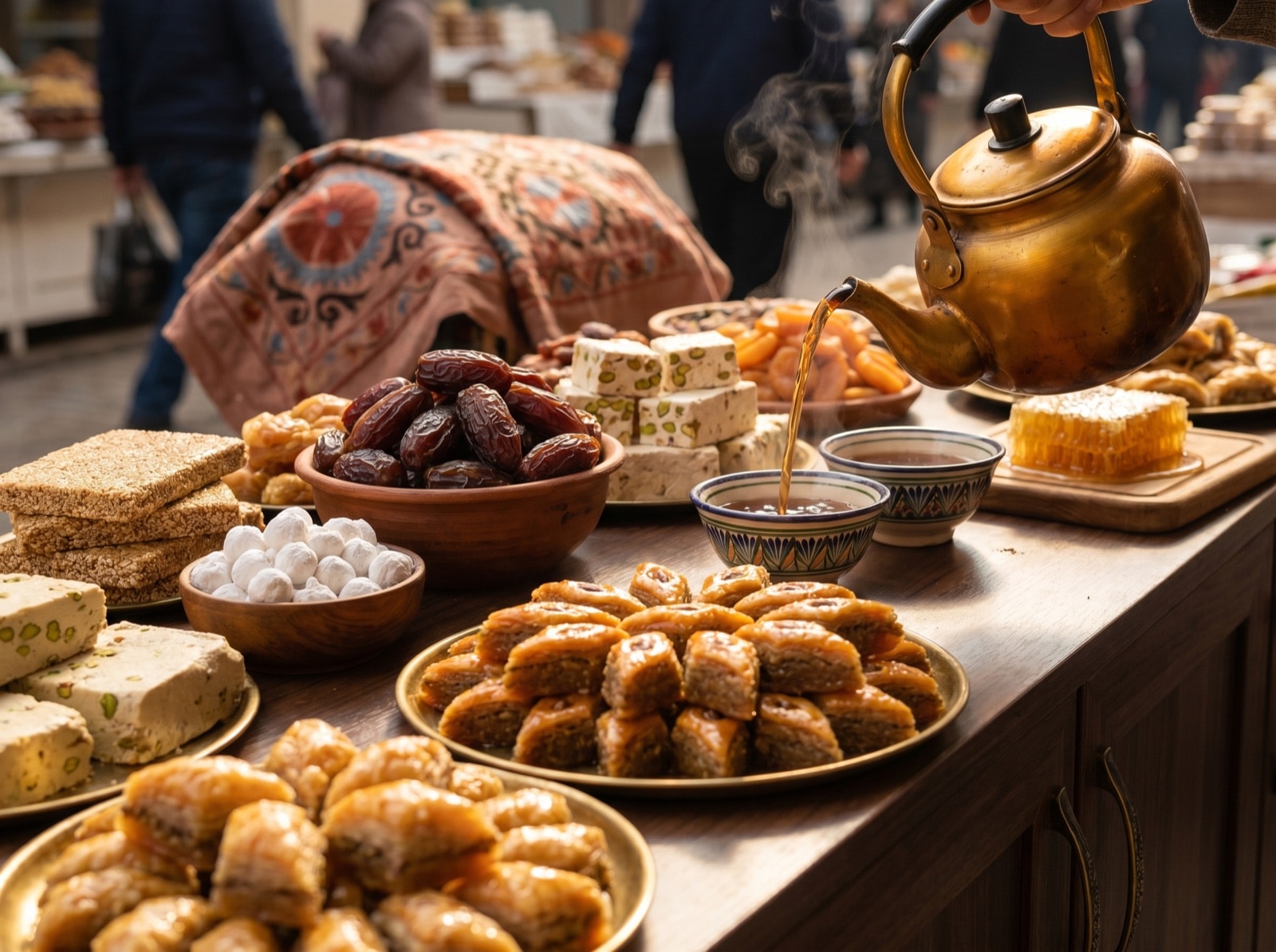
In an Uzbek home the first thing a guest gets is tea. Flatbread, dried fruit, nuts and sweets go on the dastarkhan, and navat is nearly always among them. Before serving, the host usually pours tea into a piyola and back into the pot two or three times so that it brews better. The custom is called qaytarish.
The tea itself is drunk unsweetened. People drop navat into the piyola or bite off small pieces, so each guest sweetens their tea to taste, and one pot keeps everyone topped up for a long time. Brewing and serving green kok-chai is covered in the recipe "Kok-chai: how to brew Uzbek green tea".
How to choose navat
- The crystals should be hard and dry, with no sticky film and no syrup at the bottom of the pack.
- The ingredients should be sugar and water. Grape juice, saffron or a natural flavouring also turn up, but they must be listed on the label.
- Bright yellow or orange with no saffron in the ingredients usually means a colouring. Check that it is declared.
- Sugar has almost no smell. A strong sweet-shop scent comes from added flavouring.
- Threads inside the crystals are left over from production and are not a defect.
How to store navat
Store navat as you would sugar: in a tightly closed jar, somewhere dry at room temperature and away from strongly scented spices. In the fridge, condensation forms on the crystals and they stick together. Kept in a dry jar, navat stays unchanged for a long time, but go by the date on the pack. Cloudy or fused pieces are fine to dissolve in tea, and they taste the same.
Where to buy navat in Riga
Arkan Bazar, the Uzbek bazaar at Riga Central Market (Nēģu iela 7), sells Uzbek tea, spices, dried fruit and rice. Navat is not always in stock, so check with the staff before you visit.