
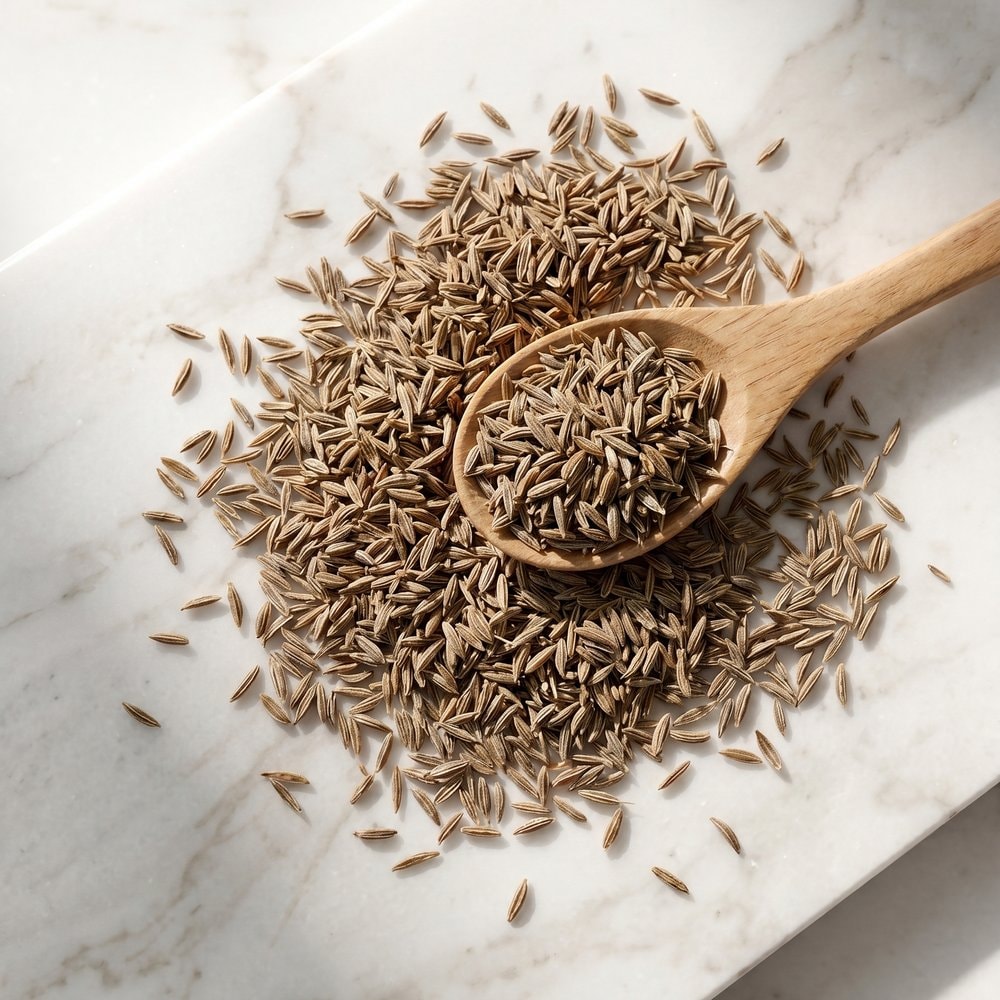
What is zira?
Zira is the Uzbek name for cumin, the seed of Cuminum cyminum, a plant of the carrot and parsley family (Apiaceae). Russian speakers say zira too. It is the main spice of Uzbek cooking, and plov, shashlik, lagman and shurpa all depend on it. The aroma is warm, slightly smoky and nutty, and it opens up the moment the seeds touch hot oil.
Indian recipes call the same seed jeera, so if you have cooked jeera rice, you already know the smell. Uzbek cooks buy whole zira seeds and keep them whole until the moment they go into the pot.
Cumin vs caraway: how to tell them apart
Caraway is Carum carvi. It belongs to the same family as cumin, and the seeds are about the same size, which is why they get confused. Put a pinch of each side by side and the differences are easy to see.
- Look: cumin seeds are lighter, a greyish brown, and almost straight, with fine ridges along their length. Caraway seeds are a darker brown with pale ridges, and curved like a small crescent.
- Smell and taste: cumin is warm and earthy, with a slight bitterness. Caraway is sharper, with a note of anise or dill.
- Cooking: cumin goes into plov, shashlik marinades and samsa filling, and into Indian, Middle Eastern and Mexican food. Caraway is the seed in rye bread and sauerkraut, it flavours cheeses, and it is common in German and Central European cooking.
In a British kitchen you are more likely to have met caraway than you think: it is the seed in old-fashioned seed cake. Cumin is the one in curry powder, in many Indian dals and curries, in Middle Eastern spice blends and in chilli con carne.
Rub a few seeds between your fingers if you are still unsure. Cumin smells like a curry or a pot of plov; caraway smells like rye bread.
Fennel seed, from the same family, is the third look-alike. Its seeds are larger and paler, often with a green tinge, and they taste sweet, of aniseed. Fennel flavours Italian sausages and is chewed after meals in India, and it is no substitute for cumin either.
Why the names get mixed up
English keeps the two words apart, but several European languages build both names from the same root. German has Kreuzkümmel for cumin and Kümmel for caraway. Russian has tmin for caraway, and cumin can appear as kumin or rimsky tmin, literally "Roman caraway". Latvian has kumīns for cumin and ķimenes for caraway, the seed in Latvian rye bread and in Jāņu siers, the cheese eaten at midsummer.
So a translated recipe, or a label read in a hurry, can easily send you home with the wrong seed. In Riga, check that the packet says kumīns, not ķimenes.
Cumin and caraway in five languages
- English: cumin; caraway.
- Uzbek: zira for cumin, qora zira for black zira. Uzbek cooking does not use caraway.
- Russian: zira, kumin or rimsky tmin for cumin; tmin for caraway.
- Latvian: kumīns for cumin; ķimenes for caraway.
- German: Kreuzkümmel for cumin; Kümmel for caraway.
Black cumin vs cumin: black zira and nigella
"Black cumin" is a name that two other plants share, and neither is ordinary cumin.
Black zira, qora zira in Uzbek, is Bunium persicum. Its seeds are darker and thinner than ordinary zira, with a finer, more complex aroma, and in Central Asia it is prized for plov and for meat. It is harder to find; at Arkan Bazar it comes in season, so ask at the counter.
Nigella, Nigella sativa, belongs to a different family altogether, the buttercup family. Its small, matt black seeds are sold in English as nigella, black seed, kalonji or, confusingly, black cumin. Uzbeks call it sedana and scatter it over non before baking; on Latvian labels it is melnās ķimenes, black caraway.
The two are not interchangeable, and both differ from cumin. When a pack just says "black cumin", look for the Latin name.
Zira vs turmeric
Turmeric is a different thing entirely: the root-like rhizome of Curcuma longa, dried and ground to a bright yellow powder. In Uzbek it is zarchava, and you will also see it sold as zerchub. People mix the two up because both go into plov spice mixes, but zira brings the aroma and turmeric brings colour and a gentle earthiness.
How to use zira in Uzbek cooking
- In plov: rub whole seeds between your palms over the pot to release the aroma. Part goes into the zirvak, and many cooks scatter a little more over the rice before covering it. Plov for four to six takes about 8 g; our classic Uzbek plov recipe gives the full amounts.
- With the plov trio: zira works alongside zirk, the dried barberry, and kashnich, coriander seed.
- In marinades: lamb for marinated shashlik sits in grated onion with zira, salt and black pepper.
- In soups: zira and coriander seed season shurpa, mastava and the sauce for lagman.
- In fillings: a pinch of crushed zira goes into the chopped meat and onion of beef samsa, and into manti and chuchvara.
Whole, toasted or ground
Uzbek cooking mostly uses whole seeds. Toasting them for a minute in a dry pan deepens the flavour, and they are easy to crush in a mortar afterwards. Uzbek cooks treat kashnich, coriander seed, the same way. If you fry zira in oil, keep it to well under a minute: it burns quickly and turns bitter.
Grind zira only when a recipe needs it ground, and only as much as you need for that dish. Ground cumin loses its aroma much faster than whole seed, so a jar of powder that has stood open for months adds little.
Can you use caraway instead of cumin?
Not one for one. The two taste different, and caraway will push a plov or a shashlik marinade towards the flavour of rye bread. If a recipe asks for zira and you have none, it is better to buy cumin than to substitute. The same goes the other way: cumin makes an odd rye loaf.
Ground cumin is a fair stand-in for whole zira, as long as it is fresh. Add it a little later than you would add the seeds, because the powder scorches faster in hot oil.
How to store zira
- Keep it whole. Whole seeds hold their aroma far longer than ground cumin.
- Use an airtight jar, somewhere dark and away from the heat of the stove.
- Buy small amounts and often. Zira keeps for many months, but the aroma is brightest in the first few.
- Check it when you buy. Good zira is whole and dry, with few broken seeds and little dust.
- Smell before you use it. Good zira smells strong and warm when rubbed; old zira smells of dust.
Where to buy zira in Riga
On Latvian supermarket shelves, cumin is labelled kumīns. For whole seeds weighed to order, go to Arkan Bazar, the Uzbek bazaar at Riga Central Market, where zira sits loose in glass jars and is weighed in front of you, from 50 g up. It comes from Uzbekistan or Iran, depending on the season. Ask about black zira while you are there: it is stocked in season.
Buying in bulk for a business? Our guide to importing Uzbek zira into the EU covers quality, documents and packaging for trade buyers.
Zira is cumin. Caraway belongs in rye bread, not in plov.