
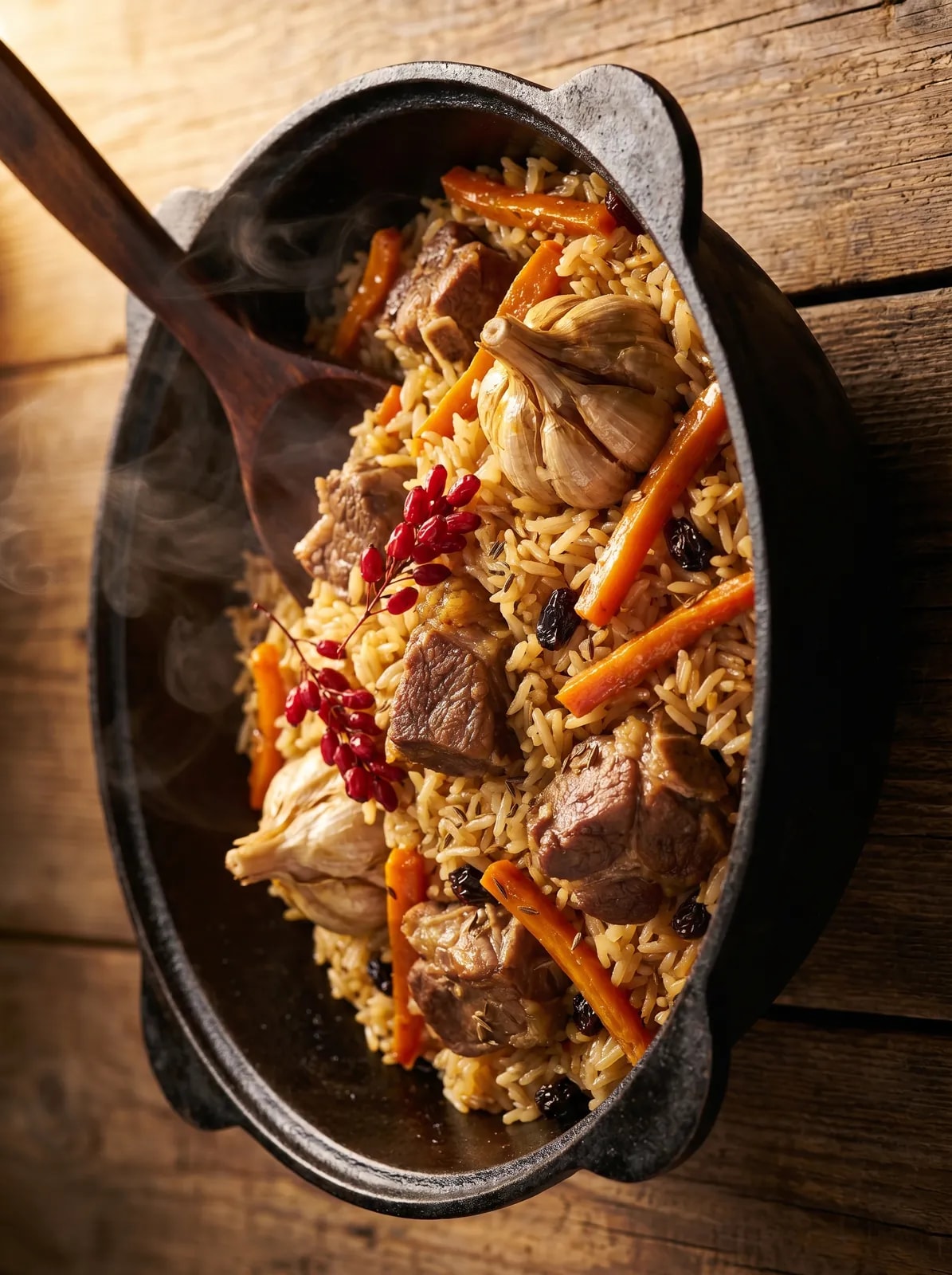
What is Uzbek plov?
Plov is the Russian and English name for the rice dish Uzbeks call osh or palov. It belongs to the same family as pilaf. In the Uzbek method the rice cooks in a heavy cast-iron kazan on top of a zirvak, a base of meat, onion and carrot, and finishes in its own steam under a lid.
Plov is widely seen as the national dish of Uzbekistan. It is cooked for family meals as well as for weddings and big gatherings, and most regions have their own way of making it. All the styles share one method, so once you understand the zirvak, the differences between them are easy to follow.
The zirvak and the three stages of plov
Plov is cooked in one pot, in three stages, and nobody stirs it once the rice is in.
- Frying. Oil or tail fat is heated in the kazan until it shimmers. The meat is browned, then sliced onion goes in, followed by the carrots, and everything fries until golden.
- Simmering. Hot water goes in with whole heads of garlic, zira and barberries, and the zirvak simmers over a low heat until the meat is tender and the broth has taken on its flavour.
- Steaming. The soaked rice is spread over the zirvak in an even layer. It cooks until the water has gone, then steams under a tight lid and rests off the heat before serving.
In Uzbekistan plov is cooked in cottonseed oil, in tail fat from fat-tailed sheep (dumba in Uzbek, kurdyuk in Russian), or in both. At home, ordinary vegetable oil works, although the flavour is not quite the same.
Carrots are cut by hand into long, thin matchsticks, never grated, so that they soften without turning to mush. Uzbek cooks value yellow carrots, which are firmer than orange ones. Our classic Uzbek plov recipe gives the core method with weights and timings, and the regional styles build on it.
Types of Uzbek plov
These are the styles you are most likely to meet, each with a recipe on our site.
Samarkand plov
Samarkand plov keeps its layers apart. In the pot the rice steams over the zirvak; on the platter it goes down first as a white mound, with the meat, carrots and zirvak on top, so every guest gets both. Typical touches are yellow and orange carrots, a little turmeric and crisp tail-fat cracklings, and the rice is usually devzira. Because it is easy to divide into portions, it is a wedding classic. Our Samarkand plov recipe shows how to plate the layers.
Fergana plov
Fergana plov is the everyday plov of the Fergana Valley, where both laser and devzira rice are grown. Its zirvak is short and concentrated, with a deep colour, and the whole pot is turned over from the bottom up before serving, so the rice, meat and carrots are spread evenly through it. The garlic comes out first and is served in its own heap. Our Fergana plov recipe is made with lamb and laser rice.
Tashkent wedding plov
Tashkent wedding plov, to'y oshi in Uzbek, is cooked in a big kazan for a crowd. Beef and lamb go in together, the carrots are boiled before they are fried, and chickpeas, raisins and turmeric give the dish its sweet and savoury character and its bright yellow colour. At weddings in Tashkent it is served as nahor oshi, the morning plov. Our Tashkent wedding plov recipe feeds ten to twelve.
Bahor: green spring plov
Bahor means spring in Uzbek. This light plov uses less oil and fewer carrots, and a great deal of fresh greens: coriander, dill, spring onions and spinach, half stirred into the zirvak and half scattered over the finished rice. It is made with lamb or chicken, or with no meat at all. Cook our green Bahor plov when the first herbs reach the market.
Many other local versions exist. Some cooks add quince, others chickpeas or raisins, but the method underneath stays the same.
How the styles differ
- Serving: Samarkand plov is served in layers. Fergana plov, like our classic recipe, is mixed from the bottom up before it goes on the platter.
- Rice: our Samarkand recipe uses devzira, the Fergana and Bahor recipes use laser, and the Tashkent recipe uses laser or a mix of the two.
- Meat: lamb on the bone is the classic. Tashkent plov uses beef and lamb together, and Bahor also works with chicken.
- Extras: chickpeas, raisins and turmeric in Tashkent plov; yellow carrots and cracklings in Samarkand plov; fresh greens in Bahor.
- Colour: Fergana plov takes its deep colour from the zirvak, Tashkent plov is bright yellow, and Bahor is a pale yellowish green.
Festive and everyday plov
Plov is the dish of big occasions. At weddings, family celebrations and other large gatherings it is traditionally cooked by men, often by an oshpaz, a plov master, working over a kazan big enough for every guest.
It is just as much an everyday meal. In Tashkent, eating plov on Thursdays is a common custom, and at home it is made in a smaller kazan, usually with laser rice.
Which rice to use
Plov needs a rice that keeps its grains whole and separate through long cooking. Laser is a long, glassy white rice and the versatile everyday choice; it needs only about half an hour's soak. Devzira is a medium-grain red rice, heavier and denser than laser, and the classic choice for festive plov, including Fergana and Samarkand plov cooked for guests. It needs at least an hour's soak in warm salted water.
Avoid round, short-grain rice, which releases starch and turns plov into porridge. Our guide to devzira and laser rice compares the two in detail.
Uzbek plov spices and extras
Plov is not a heavily spiced dish. These are the usual seasonings and extras:
- Zira (cumin): the main spice. Rub the whole seeds between your palms over the pot to release the aroma. Plov for four to six takes about 8 g.
- Barberries (zirk): small, tart dried berries that balance the fattiness of the meat. A handful, 10 to 15 g, goes into the zirvak.
- Garlic: whole heads with the loose outer skin removed, cooked in the zirvak until soft and sweet, then lifted out and served on top of the plov or beside it.
- Turmeric: a little in Samarkand and Tashkent plov, mainly for colour.
- Chickpeas and raisins: typical of Tashkent wedding plov. Cook the chickpeas separately first, and put the raisins on top of the rice so they do not break down.
- Salt: half goes into the zirvak, and the rest is adjusted at the end.
Cooking plov at home on a stove
A cast-iron kazan holds heat evenly and is the traditional pot, but a heavy-based casserole with a tight-fitting lid will do on an ordinary hob. Thin pans are the problem: the bottom burns before the rice on top has steamed.
Once the rice is in, leave it alone. Keep the lid on for the first 20 minutes of steaming, then let the plov rest off the heat for 10 to 15 minutes before you mix it and serve it. If the rice is still hard at the end, pour about 50 ml of hot water down the handle of a slotted spoon, cover and leave it on the lowest heat for another 5 to 10 minutes.
As a guide, 600 to 800 g of raw rice makes plov for three or four people, and 1.2 to 1.5 kg feeds six to eight.
How plov is served
Plov goes to the table on a lagan, a large round platter set in the middle so everyone eats from it. The meat is cut into pieces and laid over the rice, with the soft heads of garlic on top.
A sharp salad comes alongside, usually achichuk: thin slices of tomato and onion with herbs and a dash of vinegar, which cuts through the fat. Non is broken by hand and shared, and green tea, kok-chai, is poured with the meal or straight after it.
Where to buy plov ingredients in Riga
- Rice: laser and devzira at Arkan Bazar, in packs or weighed out loose.
- Spices: zira and barberries, sold loose by weight.
- Plov kit: laser rice, zira, barberries and coriander seed with a step-by-step recipe card, made up at the counter.
- Meat: lamb or beef on the bone. Arkan Bazar's halal meat pre-order is launching soon, with meat produced in Latvia, elsewhere in Europe and in Scandinavia.
- Carrots, onions and garlic: any good market or supermarket. Yellow carrots are hard to find in Latvia; orange ones with a pinch of turmeric do the job.
- Tail fat: ask at the stall.
Buying rice for a restaurant or a shop? Our guide to plov rice categories for EU buyers covers the trade varieties.
The zirvak is the same everywhere. What changes from region to region is the rice, the extras and the way plov reaches the platter.